

AWIP, International Affairs, International Relations, News Analysis
Q. “The recent political upheaval in Bangladesh marks a shift from ‘legacy-based diplomacy’ to an era of ‘uncertain transitions.’ Critically analyze how the current crisis in Bangladesh challenges India’s ‘Neighborhood First’ policy. Furthermore, in the context of the systemic vacuum created by the fall of the Awami League, discuss whether Bangladesh is facing a temporary democratic reset or a long-term descent into institutional fragility.”
Dec
The ouster of the Awami League government in August 2024 terminated a fifteen-year era of “Legacy-based Diplomacy,” where India-Bangladesh ties were anchored in the shared history of 1971 and a personalized rapport with Sheikh Hasina. The subsequent transition under the Interim Government led by Dr. Muhammad Yunus has introduced a period of strategic fluidity, shifting the relationship from a predictable partnership to one defined by systemic volatility.
I. Challenges to India’s ‘Neighborhood First’ Policy
The upheaval in Dhaka has struck the core pillars of India’s regional strategy:
-
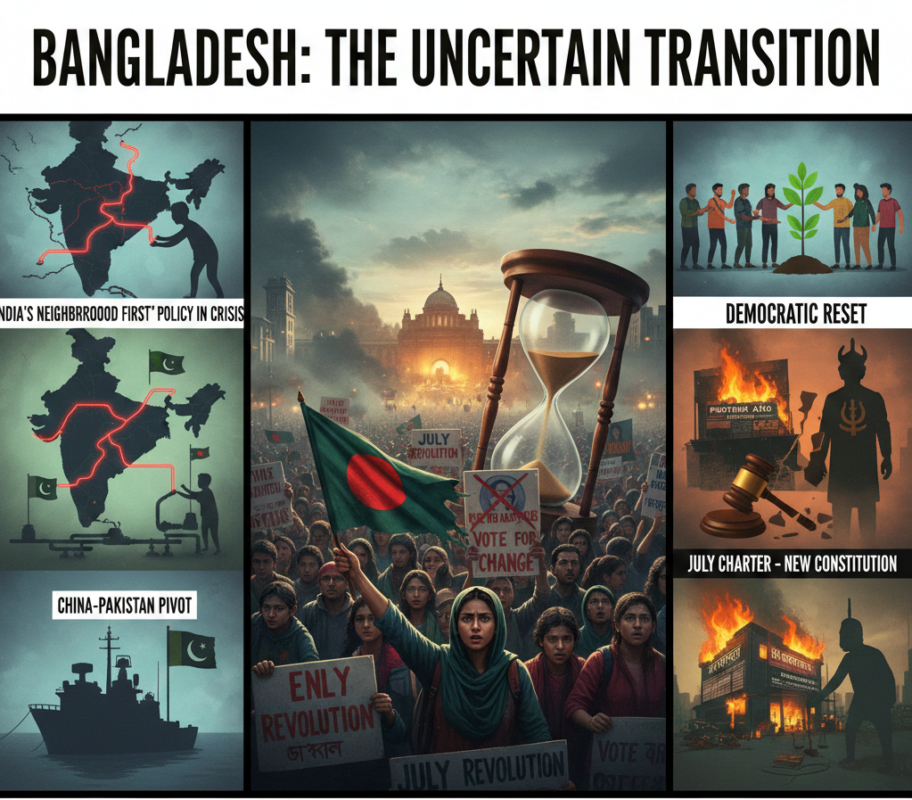
The Security Guarantee Paradox: For over a decade, Bangladesh acted as India’s “security guarantor” by dismantling anti-India insurgent camps (ULFA, NSCN-K). The current vacuum risks reviving these safe havens. Furthermore, the 2025 surge in anti-India rhetoric—symbolized by the targeting of Indian Assistant High Commissions and the suspension of visa services—indicates a breakdown in the traditional security consensus.
-
Strategic Encirclement and the ‘Pakistan-China Pivot’: The transition has witnessed a visible diplomatic recalibration. The resumption of direct maritime links with Pakistan (PNS Saif’s visit) and China’s involvement in upgrading the Lalmonirhat airfield near the Siliguri Corridor (“Chicken’s Neck”) directly challenge India’s “Red Lines” regarding external presence in its backyard.
-
Connectivity at a Crossroads: Major initiatives like the India-Bangladesh Friendship Pipeline and the use of Chittagong/Mongla ports for NE India are now viewed through a populist, nationalist lens. India’s decision to revoke certain transit facilities in late 2025 reflects a “reciprocal caution” that threatens to undo years of economic integration.
II. Democratic Reset or Institutional Fragility?
Bangladesh is currently caught between the “sovereign will” of a youth-led revolution and the practical “breakdown” of state machinery.
-
Evidence of a ‘Democratic Reset’:
-
The July National Charter (2025): The signing of the “July Charter” by 24 political parties aims at fundamental constitutional changes, including two-term limits for Prime Ministers and the separation of the judiciary—reforms long avoided by the previous regime.
-
Electoral Integrity: The formation of a National Consensus Commission seeks to “re-institutionalize” the Election Commission to prevent the rigged outcomes seen in 2014, 2018, and 2024.
-
-
Evidence of ‘Institutional Fragility’:
-
Mob-Led Governance: The repeated targeting of independent media (e.g., Prothom Alo and The Daily Star) and the lynching of political activists (e.g., Sharif Osman Hadi in Dec 2025) suggest that the “rule of the street” has outpaced the “rule of law.”
-
Majoritarian Shift: The lifting of bans on radical groups and the rise of the National Citizen Party (NCP) have created a polarising atmosphere where secularism is under siege. This institutional vacuum has allowed fringe elements to dictate state policy, moving Bangladesh closer to a “fragile state” model rather than a stable democracy.
-
Conclusion: From ‘Hasina-Plus’ to ‘People-Plus’ Diplomacy
The current crisis proves that India’s “Neighborhood First” policy suffered from over-reliance on a single political actor. While the danger of institutional collapse is real, the democratic aspirations of Bangladesh’s Gen Z offer a new avenue for engagement.
India’s way forward must be a “Diplomacy of Patience.” It must shift from a “legacy-driven” approach to a “consensus-driven” engagement—balancing its security concerns with a proactive outreach to the new political vanguard and the Interim Government. Only by decoupling its interests from specific regimes can India safeguard its strategic primacy in the Bay of Bengal.
